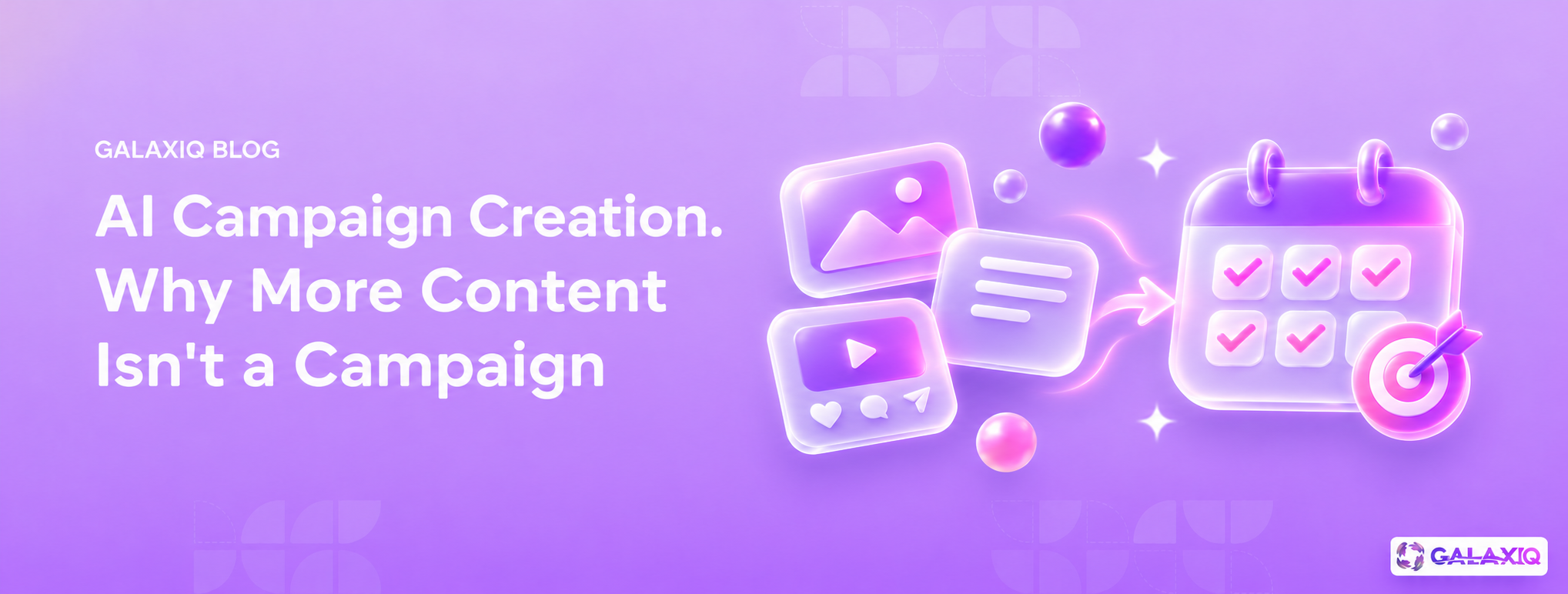
AI Campaign Creation: Why More Content Isn't a Campaign
10 min read
The speed is real. In Ahrefs' 2026 survey of 301 marketers, 93% now use AI to create or assist with content, up from 87% a year earlier, and 85% of those using it say they produce content faster, with nearly half saying much quicker. 69% say they are publishing a larger share of AI content than a year ago.
But faster pieces are not a finished campaign, and the marketers making them know it. In the same survey, 56% of AI users said human-written content is still better quality than their AI content, and 66% said they trust AI content only once a human has reviewed it. The generation got quick. The assembly, the judgement and the brand did not.
Key takeaways
- AI made content production fast. 85% of marketers using it say they work quicker, nearly half much quicker Ahrefs 2026.
- Speed created a new problem. A pile of generic pieces is not a coordinated, on-brand campaign.
- Marketers know it. 56% say human content is still better, and 66% trust AI content only after a human reviews it.
- The bottleneck moved from writing to assembly: copy, visuals, schedule, brand and audience, pulled into one thing.
- The fix is not more content. It is turning one idea into a finished campaign, on brand, in one place.
What is the campaign assembly gap?
The campaign assembly gap is the distance between a pile of AI-generated pieces and a finished campaign ready to run. Generating a caption is now trivial. Turning an idea into five coordinated posts, their matching visuals, a posting schedule, all in your brand voice and
aimed at the right segment, is not. AI closed the first gap and widened the second, because it produces more raw material that still needs assembling.
The ideas were never the slow part, and neither, now, is the first draft. The slow part is everything between the draft and the live, on-brand campaign: making the pieces agree, carrying the brand through all of them, matching them to an audience, and putting them on a
schedule. AI sped the easy step and left the hard one untouched.
| What your team sees | What is actually happening |
| Content produced in minutes | Pieces produced, not a campaign assembled |
| A full content calendar | A calendar of posts that do not add up to one idea |
| On brand because you set a tone | A tone setting, not your actual voice carried through |
| More output than ever | More to review, edit and stitch than ever |
| A caption and an image | Two assets, not a plan for who sees them and when |
Why the gap persists
Three reasons the assembly stays slow.
Generation and assembly are different jobs. AI is good at drafting one thing. A campaign is many things that have to agree with each other, in order, across channels.
The brand is not loaded in. Set to a tone, AI writes the category average. Your voice has to be carried into every piece, not implied by a dropdown, which is why 56% of marketers still rate their AI content below human work.
The audience is somewhere else. The content is made in one tool and the audience data lives in another, so targeting is a manual step bolted on at the end, if it happens at all.
Six symptoms of the assembly gap
If three or more sound familiar, your campaigns are stuck in assembly.
1. You generate fast and still launch slow. The draft takes seconds and the campaign takes a week.
2. Your posts do not sound like one idea. Each was generated on its own, so the set has no through line.
3. Everything needs a human pass. 66% of marketers trust AI content only after review, and yours is no exception.
4. Copy and visuals were made in different tools. You are the integration layer holding them
5. On brand means “we set the tone to friendlyˮ. A setting is not your voice.
6. Scheduling is a separate chore. The campaign is written, then re-entered into a scheduler by hand.
What the assembly gap costs
It rarely shows up as a line in a budget, but the cost is real.
- Slow launches. The idea is ready on Monday and live the following week, because the pieces still have to be assembled by hand.
- Diluted brand. 56% of marketers say their AI content is weaker than human work. Shipped at volume without your voice carried through, that becomes your brand.
- Wasted output. Much of what is generated is edited heavily or never used, so the speed never becomes throughput.
AI makes this worse when it only speeds the easy part. Faster drafting in front of the same manual assembly just builds a larger pile waiting at the same bottleneck.
How to test for the assembly gap in an afternoon
Run these five tests on your own process. You do not need a consultant, just a recent campaign and an hour.
1. The idea-to-live test. Time how long one real idea takes to go from brief to scheduled campaign. Count the tools and the handoffs.
2. The through-line test. Read your last campaign's posts in order. Do they tell one story, or five unrelated ones?
3. The brand test. Remove your logo from five posts. Could they belong to anyone?
4. The seam test. List who made the copy, the visuals and the schedule, and in which tools. Count the seams you had to stitch.
5. The reuse test. Of the last twenty pieces you generated, how many shipped unchanged? The gap between generated and shipped is the assembly tax.
How tools approach campaign creation
There is no single fix for the assembly gap, and each kind of tool solves a different part. The table below is a fair reading of how each one works, based on each vendor's own description, checked 29 November 2026
| Approach | How it works | Trade-off |
| AI writing tools (Jasper, Copy.ai) | Generate copy and content from prompts, in your brand voice if you set it up | Produce the words, not the visuals or the schedule, so you still assemble the campaign |
| AI ad-creative tools (AdCreative.ai, Omneky) | Generate and score ad creatives and variations for paid media | Strong for ad units, narrower than a full organic campaign |
| AI social tools (Predis.ai, Simplified) | Generate social posts and visuals and schedule them | Good for social content, but usually not tied to your audience data or wider journeys |
| Design suites (Canva Magic Studio) | Generate on-brand visuals and layouts | Produce the assets, not the copy strategy or the targeting |
| Campaign generation in the platform (GalaxiQ, Ideanise) | Turn one idea into a full campaign, copy, visuals and a schedule, using your brand voice and audience, ready to run in the same platform | Newer and less specialised than a best-of-breed creative tool. The value is a finished, on-brand campaign, not standalone depth on one asset |
The approaches can work together, and a specialist creative tool and a campaign builder solve different parts. What matters is the end state: one idea becomes a coordinated, on-brand set of posts, visuals and timing, without you as the integration layer.
How GalaxiQ treats the assembly gap
GalaxiQ is an AI marketing platform with five products that share the same brand and customer context. Ideanise is the product that turns an idea into a campaign.
- One idea in, a campaign out. Describe the campaign in a line, and Ideanise returns coordinated posts, matching visuals and a schedule, not a pile of parts to assemble.
- In your brand voice. It uses the voice BrandForge learns from your website, so every piece sounds like you, not a tone setting.
- Aimed at the right people. It draws on EdgeIQ's segments, so the campaign is built for an audience, not a generic feed.
- Ready to run in one place. The campaign is scheduled and activated in the same platform, with no export to a separate scheduler.
Turn one idea into a finished campaign, in your voice, without becoming the integration layer.
Now the cautious part. GalaxiQ was founded in Sydney in 2025, so our track record is shorter than the dedicated creative tools, which are more specialised and often produce higher-craft single assets. Ideanise is built to assemble a finished, on-brand campaign, not to win on one design in isolation. Review before you publish, the same as any AI output, and run the five tests - above on our campaigns too.
Frequently asked questions
It is the distance between a pile of AI-generated pieces and a finished campaign ready to run. AI made generating a piece quick, but turning an idea into coordinated, on-brand, scheduled posts for the right audience is still slow and manual.